
Finding Ocala Residents by Record
Start with the fact already known. A current street address points first to the Marion County Property Appraiser, while a full name can be tested in the property roll, Official Records, court index, voter lookup, and business filings. An old address belongs in the printed directory shelf and newspaper archive. Each record captures a role at a date. Ownership does not prove occupancy, a registered voter is not every adult in a home, and a deed party may have signed without living on the land.
The Ocala residents directory works best as a chain of independent checks. Match a middle name, spouse, dated address, parcel number, or legal description before deciding that two entries refer to one person. Renters and household members may never appear in property records, so a blank result is not proof that someone was absent.
- Search the Marion County Property Appraiser by owner name or street address and save the parcel identifier.
- Use the Florida voter-status tool only for an individual whose identifying details are known.
- Search Marion Official Records for deeds, liens, marriages, probate-linked instruments, and name variants.
- For an earlier household, move to Ocala city directories, newspapers, census schedules, and obituary databases.
- Ask the correct custodian for an existing record that is not posted online, with a narrow name, date, address, and record type.
Where Ocala Resident Records Live
Ocala is the Marion County seat, so several of the strongest resident records sit with county offices. The Clerk records deeds and other instruments and also maintains court, probate, marriage, plat, and tax-deed records. The Property Appraiser connects owner names with site and mailing addresses. The Supervisor of Elections handles voter services and controlled access to registration information. City Hall holds city permits, code files, boards, and other municipal records. For a full address chain, use the Ocala street directory route after confirming whether the parcel lies within the city.
Marion Elections Office
Supervisor of Elections
Marion County, Florida
Official voter services
The Marion Clerk search hub gathers the office's main record routes.
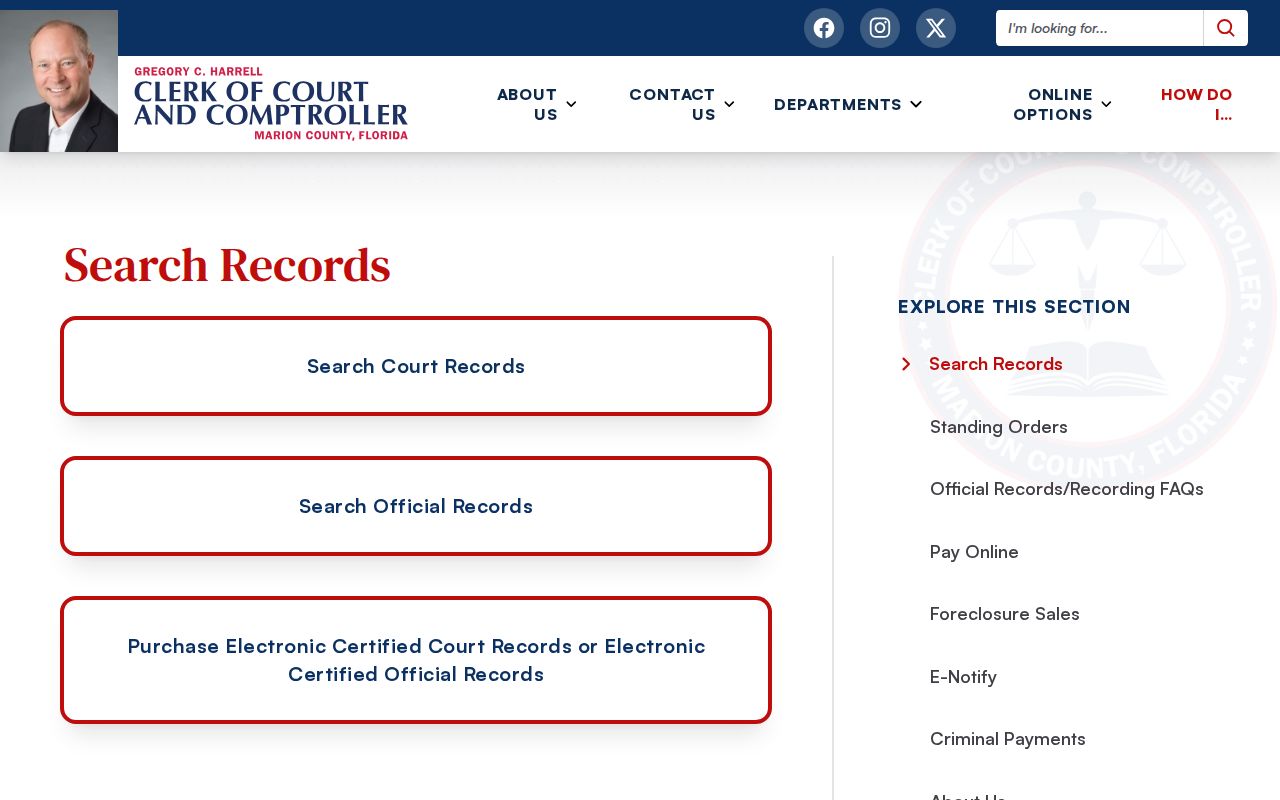
That hub is the practical fork between Official Records, court cases, tax deeds, plats, and certified-copy services.
Ocala Property Roll Search Fields
The Marion County Property Appraiser supports owner, location, parcel, subdivision, and map-based searching. Its result can show owner names, mailing and physical addresses, parcel identifiers, legal description, sale history, assessed values, exemptions, land and building details, and Official Records references. The physical or situs address identifies the parcel location. The mailing address is where the tax notice goes, and the two may differ.
| Search route | Best input | Useful output |
|---|---|---|
| Owner | Last and first name | Parcels tied to that owner |
| Location | Street number and partial street name | Improved parcels at matching addresses |
| Parcel | Parcel or account identifier | One property card |
| Subdivision | Recorded subdivision name | Parcels within that plat |
| Map | Visual area | Parcel geography and nearby land |
The Marion property search is the fastest official bridge from a name to a parcel or from an address to an owner.
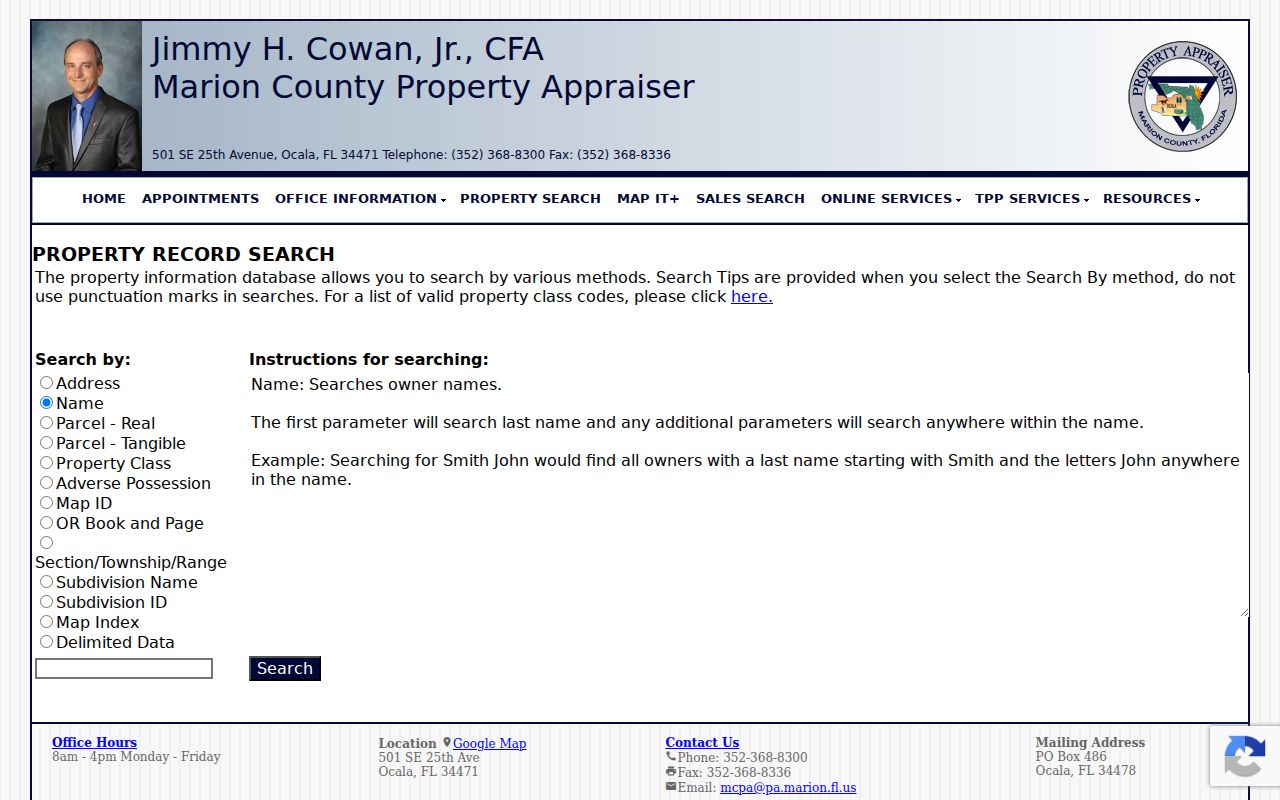
Use its parcel and deed references to continue the search, while keeping ownership and residence as separate claims.
Recorded Names Across Ocala
Marion Official Records is a party index, not a list of households. Search options include party name, document type, recording dates, instrument number, book and page, parcel, legal description, town, subdivision, and several specialized indexes. A grantor transfers an interest; a grantee receives it. Filters can separate deeds from mortgages, satisfactions, liens, judgments, marriage records, and other documents that happen to share a name.
General online coverage is dependable from 1967 forward, with marriage licenses from 1965. Special digitized books cover 1959 through 1964. Earlier records remain a Record Center and microfilm task. Online images may be limited even when the index is public, and registered-user access to restricted web images is listed at $150 per year. Counter or research-request copies cost $1 per page, certification costs $2 per document, and a staff name-and-year search costs $2.
- Index
- A finding tool that points to a recorded item; it is not the full document.
- Parcel
- A mapped unit of land with its own county identifier.
- Legal description
- The lot, block, subdivision, metes-and-bounds, or other land wording used in recorded instruments.
- Criss-cross directory
- A directory arranged by street and house number rather than only by surname.
The Official Records party search displays the local index used to connect names with deeds and other filings.
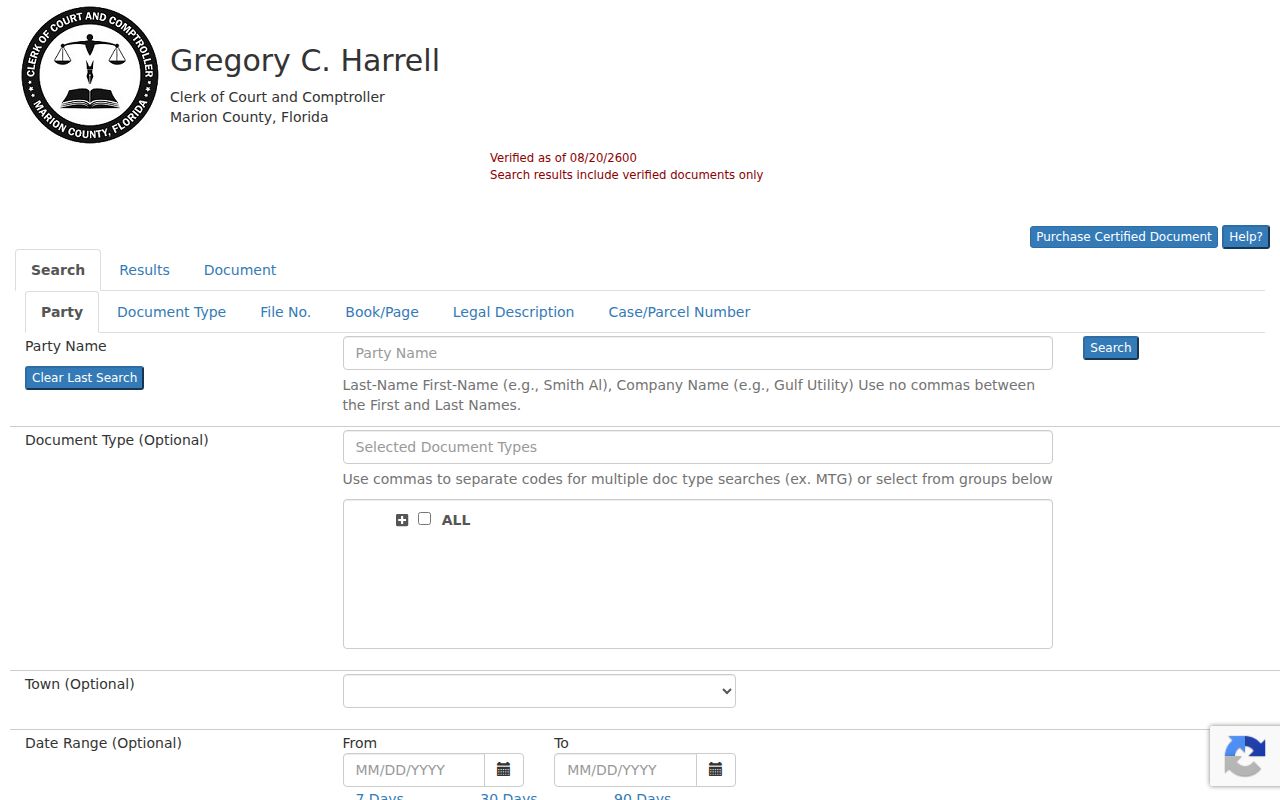
A matching legal description and recording sequence carry more weight than a shared name alone.
Current Ocala Directory Sources
No official source lists every Ocala resident. Instead, public rolls record ownership, registration, court events, filed business roles, licenses, incarceration, or unclaimed property. The source should match the question, and its date and limits belong in any conclusion.
| Ocala source | People represented | Custodian | Access path |
|---|---|---|---|
| Property roll | Owners and mailing contacts | Marion Property Appraiser | Free search |
| Official Records | Parties to recorded instruments | Marion County Clerk | Free index, image limits vary |
| Voter registration | Registered voters | Election officials | Individual lookup or lawful extract |
| Court index | Named case parties | Marion County Clerk | Public and role-based access |
| Sunbiz | Officers, agents, and filed business roles | Florida Division of Corporations | Free search and filed images |
An Ocala resident lookup needs care with similar names. Compare dates, addresses, spouses, parcels, and filed roles before treating separate results as one person.
Florida Voter Records in Ocala
The state voter-status page is an individual verification tool, not a street browser. It asks for identifying data and can confirm registration details for the person using it. Florida law treats a broader group of registration fields as public, including name, address, date of birth, party, phone, and email, but it protects Social Security numbers, driver-license or state-ID numbers, signature source and image, and approved protected-voter addresses. Registration never reveals how anyone voted.
Florida also offers statewide voter extracts under statutory rules. Current 2026 procedure uses a monthly disk schedule, requires 24 hours' advance notice, and provides pickup or mail rather than email delivery. That bulk process is distinct from checking one's own status. Suppressed Safe Address records and other statutory exemptions must remain protected in any lawful personal research.
The Florida voter information lookup shows the fields needed for an individual status check.
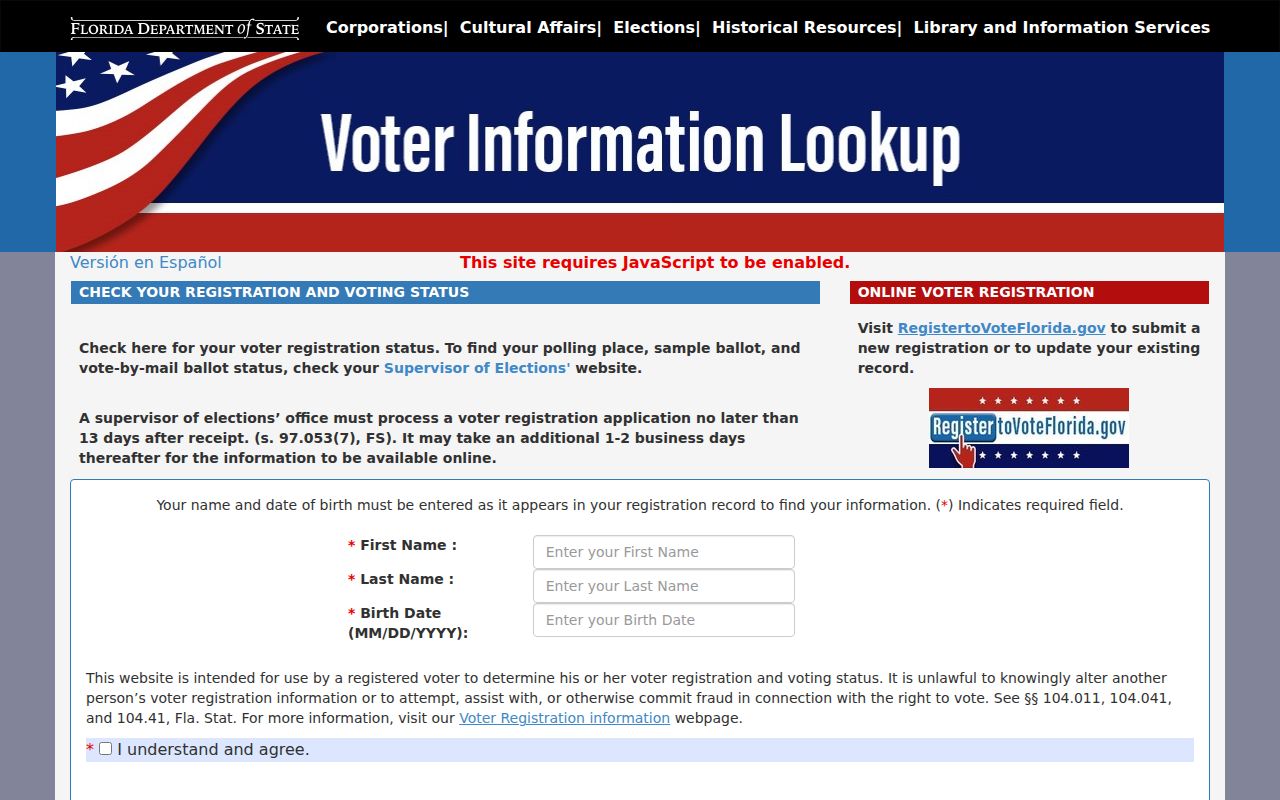
Use it as one dated confirmation, then compare only public facts with another official record.
Ocala Court and Probate Names
Marion Online Court Records Search covers county and circuit matters. Search modes include person or business name and case number, with filters such as court type, case type, party type, open or closed status, and filing dates. Results can include the case number, style, division, filing date, status, party names and roles, docket text, and events. A docket is the chronological list of filings and actions. Document visibility varies by user role and by confidentiality rules.
Probate can be especially useful for family history and heir questions. A deceased person's file may name a personal representative or interested parties, while a later estate deed can connect the probate matter to land. Court names still require identity checks. A case index proves that a name appears in a case, not that the person at a similar Ocala address is necessarily the same individual.
The Marion Online Court Records Search is the official county case-search route.
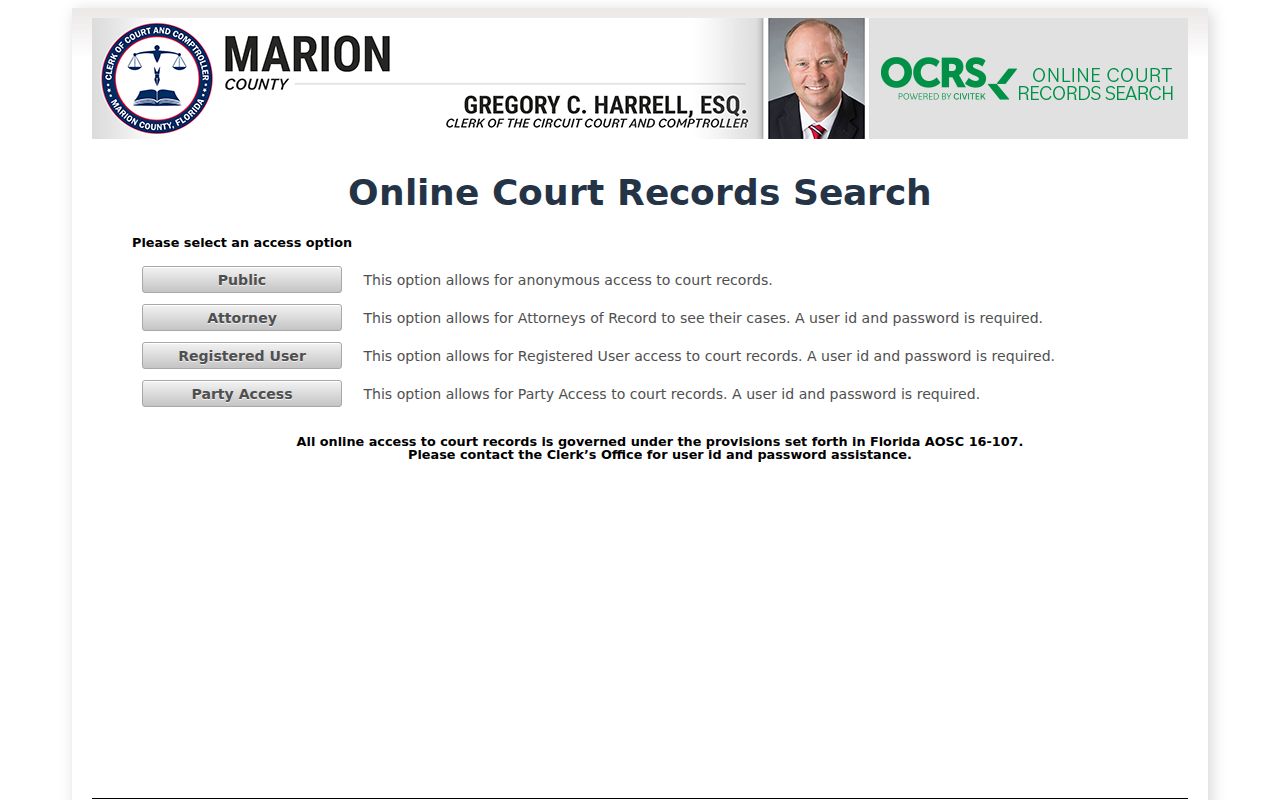
The result index supplies the case trail; certified copies and restricted documents still require the Clerk's proper channel.
Requesting Ocala Public Records
Florida's Public Records Law rests in Chapter 119, especially sections 119.01 and 119.07, and in article I, section 24 of the state constitution. A requester generally does not need to state a reason. The agency must provide prompt access to existing nonexempt records, but Florida does not impose one universal number of response days. Agencies do not have to create a new record or answer research questions.
Choose the custodian before writing. Ocala's City Clerk routes city requests through JustFOIA, email, mail, phone, or in-person service. Police and fire records have their own city contacts. County deeds and older recorded material go to the Marion Clerk, property data to the Property Appraiser, and voter material to election officials. Include the record type, date range, address or name, case or permit number when known, and desired format. Ask for a cost estimate if the request may require extensive staff time.
The Ocala JustFOIA portal is the city's online intake for a focused records request.
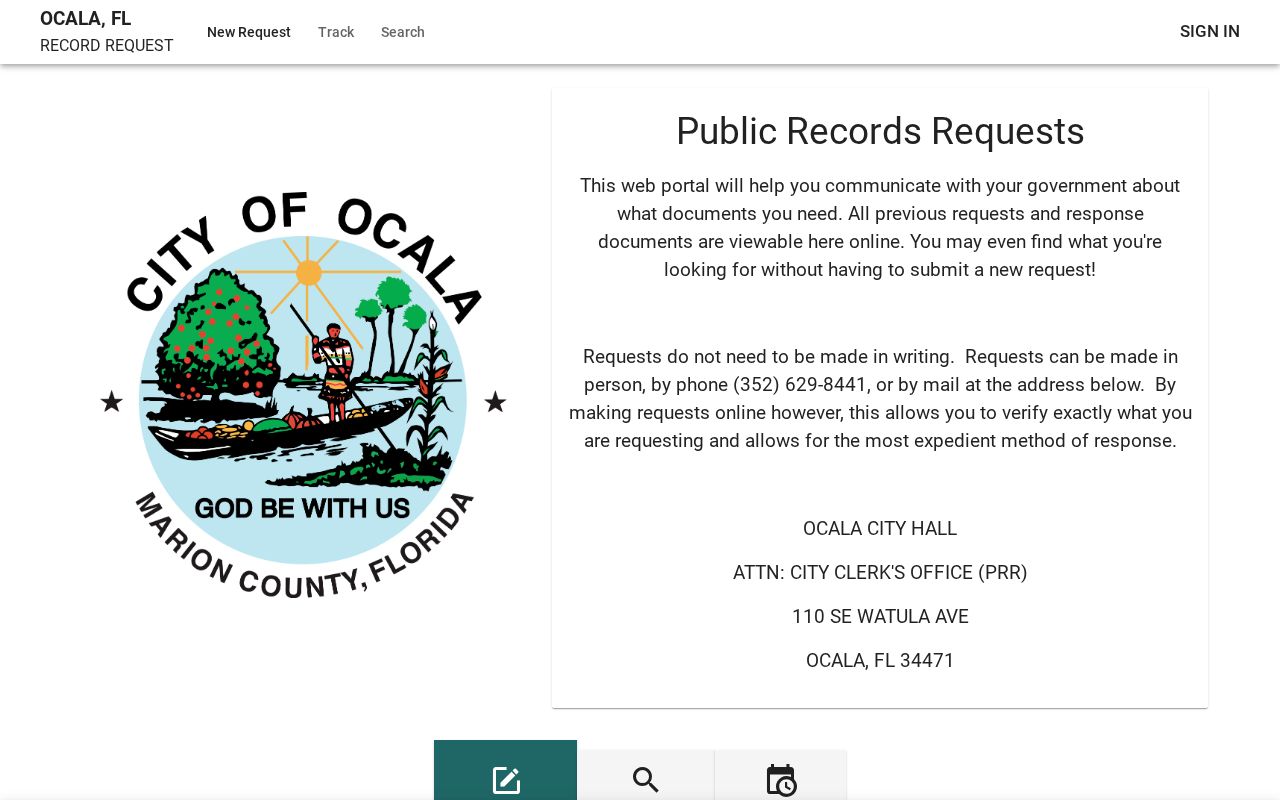
That form sends the request into the city workflow; it does not replace county or state custodians.
Ocala Mailing Lines and Limits
An Ocala postal address does not prove that a parcel lies within incorporated Ocala. The USPS delivery name extends into unincorporated Marion County. That distinction changes where permit, inspection, code, and planning records are kept. Verify the address with USPS, locate the parcel in county GIS, and compare it with the city boundary before choosing a city or county request channel.
The same care applies to address wording. Marion County uses quadrant prefixes such as NE, NW, SE, and SW, and compound labels such as Court Road and Street Road. Omitting a direction or road type can point to the wrong parcel. The county Master Street Address Guide lists address ranges, postal community, and odd or even sides, making it a stronger jurisdiction check than a ZIP name alone.
Official Rolls Versus Compilations
Official records have a named custodian, a stated purpose, and a way to request a copy or correction. They can still be old, incomplete, exempt, or easy to misread. Commercial people-finder compilations mix data from many sources, may lag behind moves and corrections, and often hide details behind fees. They should never replace the underlying deed, parcel card, docket, voter record, or certificate.
Official Ocala sources
Best for a dated fact tied to a public duty. Search and copy rules come from the office that keeps the record.
Commercial compilations
Useful only as unverified leads. Names, relatives, phones, and addresses may be joined incorrectly or remain long after a change.
Correct an error at its source. The Property Appraiser handles its parcel data, the Clerk handles recorded and court indexes, election officials handle voter records, and a private compiler controls its own listing.
Historical Ocala Directory Shelves
Ocala's printed directory trail begins with an 1886 regional volume that mentions the city. Standalone R. L. Polk evidence starts in 1908/09, and surviving indexed microfilm editions continue with gaps through 1960. Later volumes expanded beyond the city to named Marion County communities. The National Archives holds Ocala and Marion directories for 1925, 1927, and 1930, a useful bridge around the federal census.
Directory entries can list a resident, spouse, occupation, employer, home address, and marks for home ownership, but each volume reflects its compilation date and abbreviations. The Marion County Public Library adds obituary, newspaper, genealogy, and Historic Marion image databases. Its digital local-history collection contains more than 1,000 photographs, postcards, and prints. The State Library, FamilySearch Center, Genealogical Society, and historic newspapers add ways to test a directory find. Exact collection years and reading methods belong to the Ocala city directory collections.
Ocala's 1883 Records Break
On November 29, 1883, a Thanksgiving Day fire destroyed most of downtown and, according to the Marion County Sheriff's official history, much of Ocala and Marion County's recorded history. The loss explains why a modern name search cannot recover every early resident. Brick and fire-resistant rebuilding helped establish Ocala's Brick City identity.
The first digitized Ocala Sanborn fire-insurance map dates to June 1884, giving researchers an unusually close picture of buildings just after the disaster. Florida Memory also preserves a Works Progress Administration Historical Records Survey transcription of early county commission minutes. Those sources are valuable, but a transcription must be labeled as a copy rather than treated as a surviving original. Early land maps, newspapers, deeds, probate files, and later directories can overlap where one record series breaks.