
Ocala Previous Resident Sources
The backward trail changes by era. Modern property data points to today's acquisition deed. Clerk books and microfilm carry the land chain farther back. Directories and census schedules then add people who lived at the address but did not own it. Maps and permits describe the structure rather than its household.
| Source | Years It Covers | Where Held | What It Shows |
|---|---|---|---|
| Property card | Current roll and sale history | Marion Property Appraiser | Parcel, owner, site and mail address |
| Official Records | Dependable web run from 1967 | Marion County Clerk | Deeds, parties, dates, legal text |
| Historic books | 1959-1964 | Clerk digital books | Bridge before the main web run |
| Older records | Before web coverage | Record Center microfilm | Earlier instruments, indexes, plats |
| Ocala directories | 1886 regional; 1908/09-1960 with gaps | Libraries, NARA, archives | Listed householders and addresses |
| Sanborn maps | Nine editions, 1884-1924 | Library of Congress | Building footprint, use, street context |
A deed establishes a land event. A directory is a publisher's snapshot. A census identifies a household on one enumeration date. Agreement among them is far stronger than any item alone.
Start an Ocala Address Today
Search the Marion County Property Appraiser with a short address and omit city, state, and ZIP. Copy the parcel number, site address, legal description, owner name, owner mailing address, and latest sale reference. The parcel and legal text remain useful when street wording changes.
Owner mail may point elsewhere. It is where the tax notice goes, not proof that the named owner lives on the parcel. Sale history may omit a non-sale transfer, so use its Official Records reference to inspect the actual instrument.
For current street-by-street inspection, use the Ocala street directory. A previous-resident search stays with one property's backward chain.
Trace Ocala Owners Seller by Seller
Open the acquisition deed in Marion Official Records. The grantor gives the interest and the grantee receives it. The seller on the current deed becomes the name to search as an earlier grantee. Match the legal description at each step because a common name may own several properties.
- Copy today's parcel, legal description, owner, and deed reference from the property card.
- Open that deed and record its parties, instrument number, date, book/page, and legal text.
- Search the grantor as a grantee in an earlier date range.
- Reject hits with a different land description, then repeat from the matching deed.
- At the web cutoff, move to historic books and Record Center microfilm.
- Grantor
- The party giving or selling the recorded interest.
- Grantee
- The party receiving the recorded interest.
- Chain of title
- The linked sequence of transfers for the same land.
- Legal description
- The recorded land identity, such as lot, block, subdivision, or metes and bounds.
Trusts, estates, quitclaim deeds, name changes, and boundary adjustments can interrupt a neat sequence. Search individual and entity forms, and inspect related instruments.
Cross Ocala's Online Record Edge
General Official Records are reliably online from 1967, though some Clerk descriptions begin at 1965. Separate digitized books cover 1959 through 1964. Earlier deeds and indexes require the Record Center at 870 NW 4th Avenue or a mail request. Ask staff for the cutoff for the specific record.
The Clerk explains the offline research request and fees:
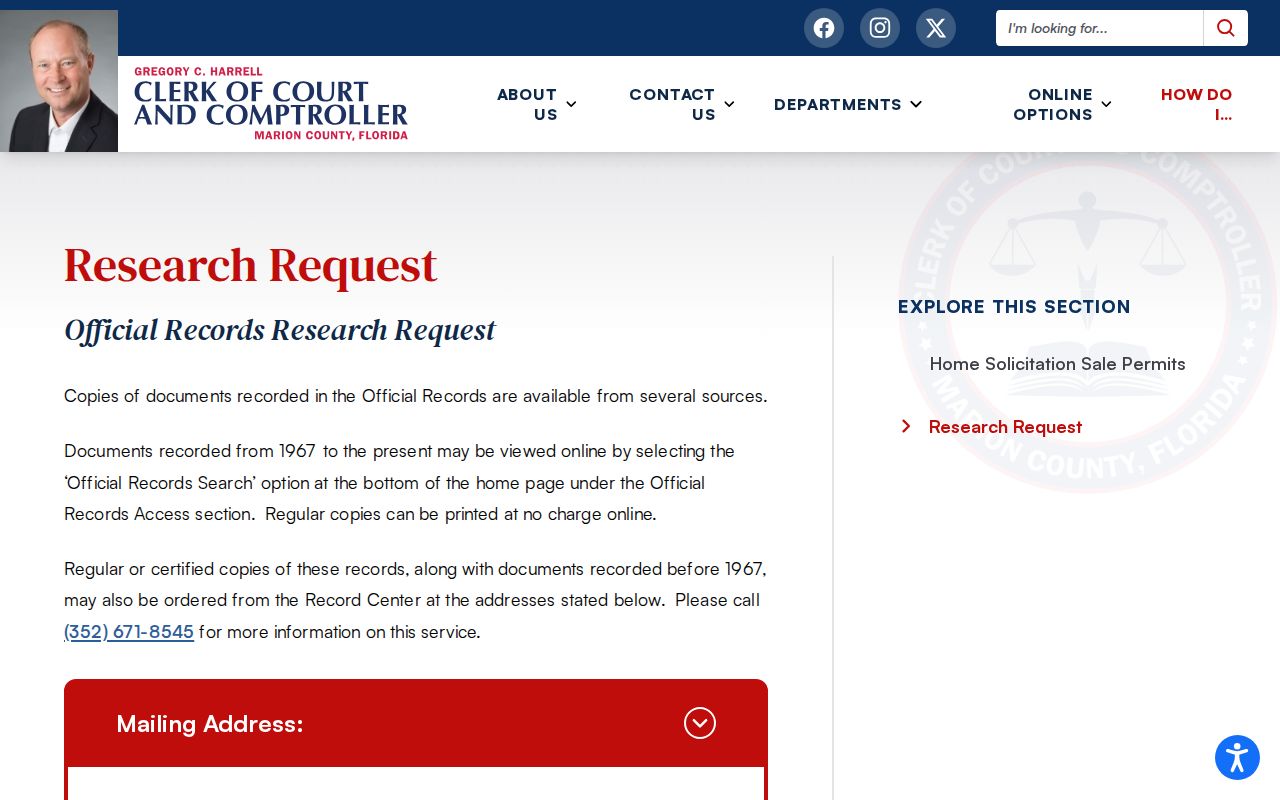
The service costs $1 per page, $2 to certify a document, and $2 for a name-and-year search. This is the practical bridge when previous residents disappear from the modern portal.
Keep Ocala Land Identity Stable
A street number is convenient, but the parcel and recorded plat endure better. A subdivision plat can show lot and block, roads, and rights of way used by deeds. The Clerk's plat service explains access.
The source page is captured here:
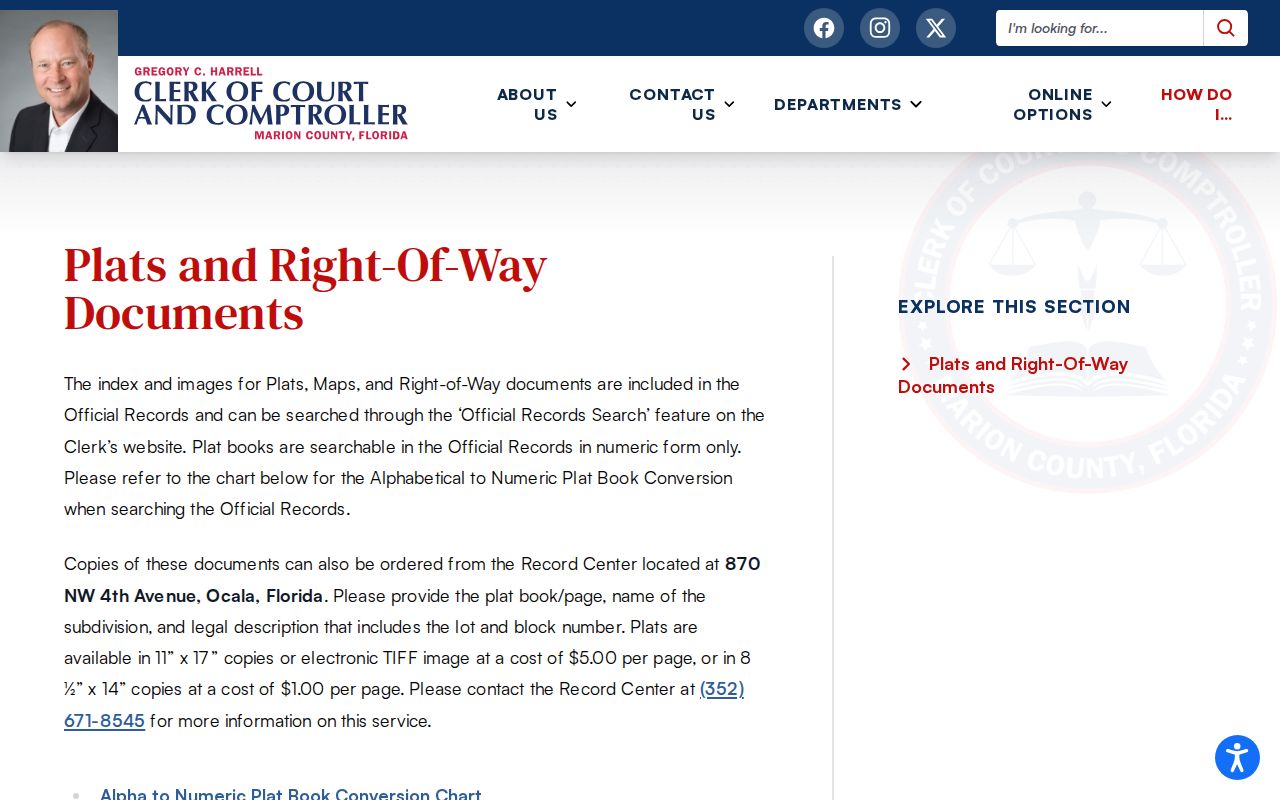
A matching lot and block can reconnect deeds when address forms differ. The plat proves legal geography, not a resident.
Nine Maps Track Ocala Buildings
The Library of Congress provides nine digitized Ocala Sanborn editions: June 1884, February 1888, January 1890, January 1892, January 1895, December 1899, December 1907, October 1912, and January 1924. Building outlines, construction notes, uses, and street context can show when a structure appeared or changed.
The first map came only months after the Thanksgiving 1883 fire that destroyed most downtown and much recorded local history. June 1884 gives an unusually close post-fire visual baseline. It does not restore missing deeds or identify every occupant.
Compare editions in sequence. Record the sheet, street label, footprint, and nearby landmarks, then return to directories, deeds, and census schedules for names.
Pair Ocala Directories With Census
Ocala's directory trail starts with an 1886 regional volume. Standalone R.L. Polk evidence begins in 1908/09, and an accessible microfilm index continues with gaps through 1960 as editions expand to county communities. NARA holds Ocala and Marion directories for 1925, 1927, and 1930.
- Choose an edition closest to the target census year.
- Find the street and number in its address section.
- Copy the householder, then check the alphabetic entry for spouse, work, and abbreviations.
- Search the census by that name and area, then compare household members.
- Return to deeds and maps to confirm the same parcel and structure.
The directory may catch a move between census years. The census can add relatives and boarders omitted by a directory. The Ocala city directory collections are covered in full on the historical page.
Get Ocala House History Help
The Marion County Genealogical Society offers free attempts at simple local lookups, plus volunteer and member research help. Cemetery transcriptions can link a former householder to a burial place. The Ocala FamilySearch Center provides local books, computers, microfilms, printers, trained help, and some affiliate-only images.
The Ocala FamilySearch Center lists its local services:
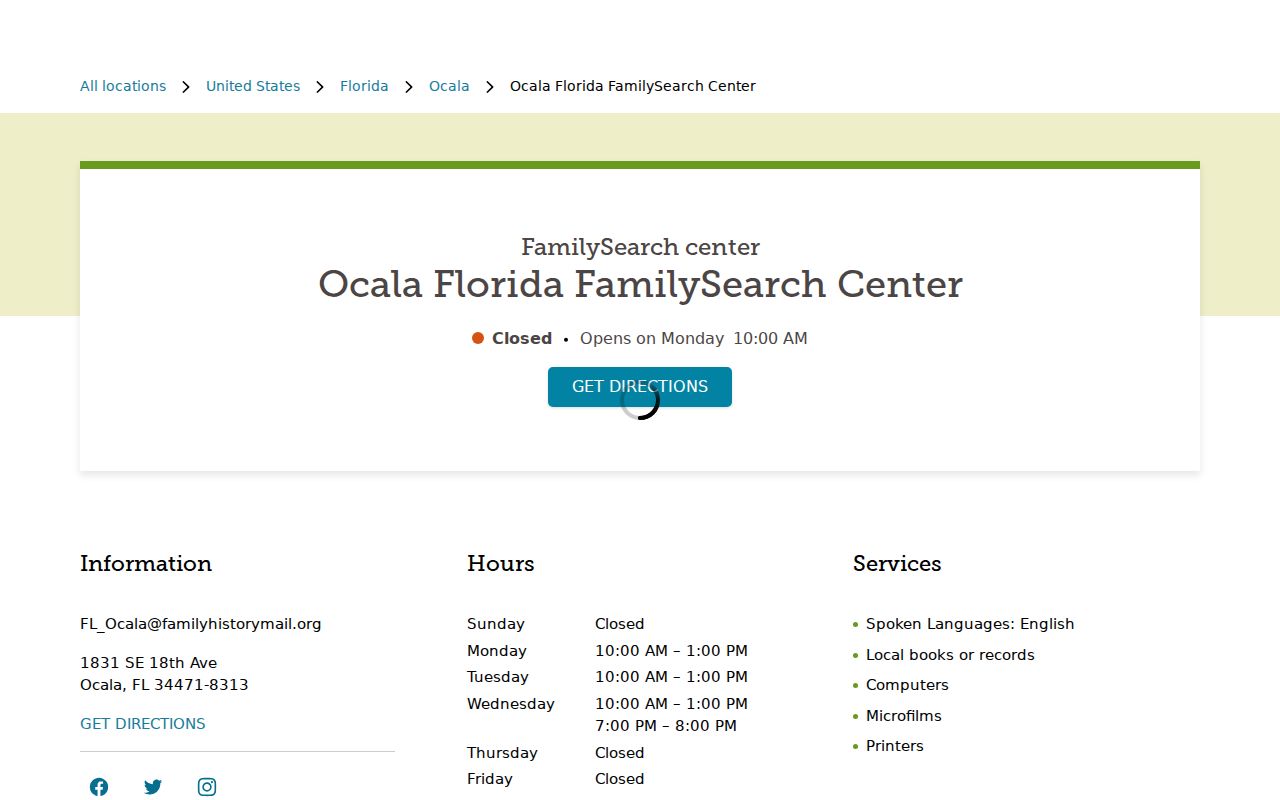
The center helps when an image cannot be opened from home or when an old place name needs local context.
Marion County Public Library's Historic Marion collection adds more than 1,000 photographs, postcards, and prints from the late nineteenth through mid-twentieth centuries. Images can identify a building or business setting even when they do not name a household.
The Ocala Fire Broke Trails
On November 29, 1883, a Thanksgiving Day fire destroyed most downtown and much recorded local history. Missing paper from that era is a real archival gap, not proof that no transaction or resident existed. Later transcripts and maps need clear labels because they are substitutes, not surviving originals.
Florida Memory preserves a WPA transcription of early Marion County Commissioners' minutes. The post-fire Sanborn map and newspapers supply more context. Putnam County's creation in 1849 and Levy County's western acquisition in 1877 can also change the custodian for early land.
Note: Search county communities and old place labels when an early person does not appear under Ocala.
Confirm Ocala's Past Households
Previous owners are only part of the story. A directory or census may name people who lived at the address without holding title. Permit files can date work and name owners, applicants, or contractors, but they cannot prove occupancy. Keep each role attached to its source.
When a resident vanishes from later editions, search local newspapers or library obituary tools. An obituary can suggest a death date, relatives, and burial place. Confirm the event through a death record where access permits, then check Marion probate files for an estate that may explain the next deed.
The Clerk records probate matters, and the county library provides genealogy, obituary, and Ocala Star-Banner database access. A death certificate without cause is public in Florida, while cause-of-death information is restricted for 50 years.
Lawful use. Research Ocala previous residents for house history, genealogy, or lawful personal curiosity. Never use a record trail to track, harass, threaten, or harm anyone.
Safety programs can suppress current addresses. Respect those limits. Say “listed at,” “recorded owner,” or “named in probate” rather than treating one record as a complete life story.